
PAYMENT ORCHESTRATION SOLUTIONS
Business Expansion helps digital businesses assess orchestration requirements, select suitable platforms and payment providers, coordinate onboarding and implement multi-provider payment setups
Why Payment Orchestration Solutions Matter
Payment orchestration solutions connect and manage multiple gateways, processors, acquirers and other payment providers through one controlled layer, making them an important part of a wider Payment Infrastructure Solutions setup.
A payment gateway processes a transaction through a specific provider route. A payment orchestration layer selects and manages transactions across several possible routes. It does not replace the gateways, processors, acquirers or merchant accounts that process and settle the payment.
Different orchestration solutions support different provider connections, routing rules, fallback models, markets and integration requirements. Choosing the right setup matters because a platform suitable for one business may not support another business’s existing providers, transaction flows or operational requirements.

When a Payment Orchestration Solution May Be Needed
A payment orchestration solution may be required when a digital business needs to manage several payment providers, introduce routing and fallback rules, expand across markets or restructure fragmented integrations that are difficult to control through separate connections.
Managing Multiple Payment Providers
Connect gateways, processors, acquirers and other payment providers through one controlled setup.
Adding Routing and Failover
Apply provider-selection rules, cascading, retries and backup routes when the primary route is unavailable or unsuitable.
Expanding Across Markets and Payment Routes
Coordinate different providers by country, currency, payment method, legal entity or transaction type.
Restructuring an Existing Payment Stack
Introduce an orchestration layer around existing providers or replace fragmented connections without rebuilding the entire payment flow.
Not every business requires payment orchestration. Where one provider and one route can support the required markets, payment methods and transaction flow, a simpler gateway setup may be sufficient.
Who Payment Orchestration Solutions May Be Suitable For
Payment orchestration requirements differ depending on the business model, transaction flows, provider stack and operating markets. Business Expansion supports the selection and implementation of orchestration solutions including the following digital business verticals:

FinTech Businesses
Payment providers, financial applications, embedded finance products, remittance services and other FinTech platforms that need to manage multiple processors, acquirers, payment methods or transaction routes within one controlled setup.
Explore FinTech Payment Solutions

iGaming Businesses
Online casinos, sportsbooks, gaming platforms and white-label operators that need to coordinate multiple deposit providers, acquiring routes and backup connections across different markets, brands or legal entities.
Crypto Businesses
Crypto exchanges, wallets, token projects, OTC platforms, DeFi products and other blockchain businesses that need to coordinate fiat, stablecoin or crypto payment providers within a multi-provider payment setup.
Why Payment Orchestration Support Matters
Connecting an orchestration platform may appear straightforward, but implementing a setup that works across several gateways, processors, acquirers and payment methods requires multiple connected decisions. The underlying providers, merchant accounts, routing rules, fallback routes and operational responsibilities must work together within one payment infrastructure.
Even when an orchestration solution appears suitable, provider compatibility, routing capabilities, cascading logic, transaction-status mapping, reporting and integration models can vary significantly between platforms. Researching, validating and implementing the available options can require substantial time and resources.
Payment orchestration support helps businesses determine whether orchestration is required, select suitable platforms and payment providers, define the required multi-provider configuration and coordinate its implementation.
Payment Orchestration Setups We Help Implement
Payment orchestration setups differ in how the orchestration functionality is provided and how it connects with existing gateways, processors, acquirers and payment methods. Business Expansion helps determine and implement the model that fits the required transaction flows, provider stack and operational requirements.
Orchestration Solution Models
Independent Payment Orchestration Platform
A gateway-agnostic orchestration layer connected with multiple payment providers, processors and acquiring routes.
Orchestration Through a PSP or Payment Platform
Routing and multi-provider management capabilities provided as part of a broader payment processing platform.
Custom or Hybrid Orchestration Setup
An orchestration platform combined with business-specific routing or integration logic where a standard product does not fully support the required setup.
Orchestration Integration Models
Orchestration Around an Existing Payment Stack
An orchestration layer introduced around existing gateways and processors, allowing suitable providers to remain in place.
Centralised Orchestration Integration
The platform, application or checkout connects with one orchestration layer, which selects and manages the underlying payment route for each transaction.
How a Payment Orchestration Setup Works
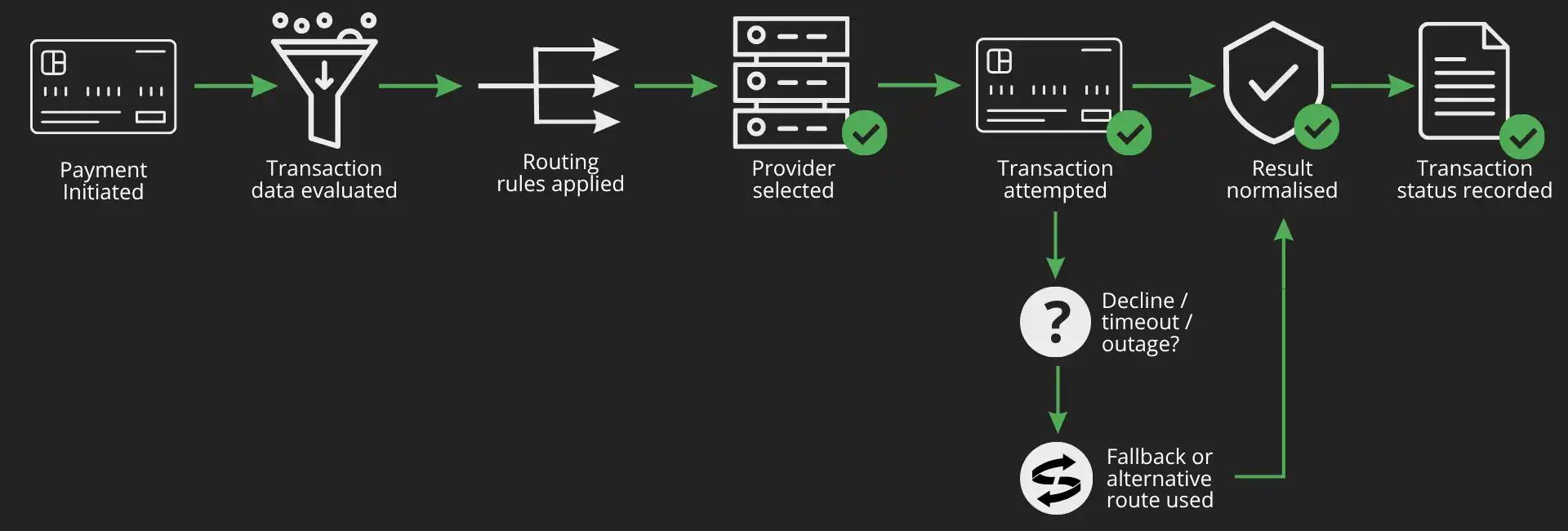
After a payment is initiated, the orchestration layer evaluates the transaction data, applies the configured routing rules and selects an appropriate payment provider. If the first route cannot complete the transaction because of a decline, timeout or provider outage, a controlled fallback, retry or alternative route may be used.
Once the transaction is completed, provider responses and statuses are normalised within the orchestration setup. The orchestration layer manages the routing decision and transaction handling, while the selected gateway, processor, acquirer or other underlying provider processes the actual payment.
What Determines Payment Routing
Payment routes may be selected according to the market, legal entity, currency, transaction amount, payment method, issuer or bank data, provider availability, commercial terms, historical performance and provider-specific eligibility requirements.
These conditions determine which routes should be primary, secondary or conditional and what should happen after a decline, timeout or provider outage.
Payment orchestration can provide greater control and provider flexibility, but it does not guarantee higher acceptance rates, lower processing costs or uninterrupted payments. Results still depend on provider coverage, merchant eligibility, commercial conditions and the routing rules applied.
Payment Orchestration Integration
Once the orchestration solution, underlying payment providers and routing configuration have been selected, the orchestration layer must be connected with the website, application or existing payment stack. Depending on the setup, this may involve integrating gateways, processors and acquirers, configuring routing and fallback rules, and normalising transaction statuses and provider responses.
Business Expansion coordinates the overall implementation, including provider onboarding, configuration and technical delivery. Custom integration or orchestration logic can be completed through CodeSolution or coordinated with your existing technical team to ensure the selected providers and routes work correctly within one controlled payment setup.

Our Payment Orchestration Solutions Process
The goal of Business Expansion is simple: determine whether payment orchestration is required, identify a suitable multi-provider setup and support platform selection, provider onboarding and implementation.
Share Your Requirements
Tell us about your product, target markets, existing payment providers, transaction flows and the orchestration task you need to solve.
Business & Orchestration Review
We review your provider stack, payment routes and operational requirements to determine whether orchestration is justified and what the control layer should support. Where a deeper assessment is required, we may recommend starting with a Payment Solution Diagnosis.
Platform & Provider Selection
We define the suitable orchestration configuration and identify platforms, gateways, processors, acquirers and routing options that may support your business requirements.
Onboarding & Implementation
We support provider onboarding and coordinate orchestration configuration and technical implementation through CodeSolution or with your existing development team.

Why Work With Business Expansion
Payment orchestration platforms usually focus on their own technology, while gateways, processors, acquirers and technical teams cover only their part of the setup. Business Expansion brings orchestration assessment, platform and provider selection, onboarding and implementation into one coordinated project, so the business does not need to manage each workstream independently.
We are not limited to one orchestration platform, PSP, gateway or acquiring route. We can implement a new multi-provider setup, introduce an orchestration layer around existing providers or restructure fragmented payment connections, with technical delivery through CodeSolution or your own team.
FAQ
How is payment orchestration different from a payment gateway?
A payment gateway connects a checkout, application or platform with a specific processing route. Payment orchestration sits above or around multiple gateways and providers, selects the appropriate route for each transaction, applies fallback or cascading rules and normalises provider responses. It coordinates the underlying providers but does not replace the gateways, processors, acquirers or merchant accounts that process and settle payments. Learn more about selecting and integrating an individual route in Payment Gateway Solutions.
When is payment orchestration not necessary?
Payment orchestration may not be necessary when one gateway or provider supports the required markets, currencies, payment methods, transaction volumes and reporting requirements. Where the business does not need backup routes, conditional routing or centralised control across several providers, orchestration may add cost and operational complexity without providing sufficient value.
Can payment orchestration work with our existing gateways and processors?
Yes, orchestration can often be introduced around an existing payment stack without replacing every provider. This depends on API compatibility, supported transaction data, status mapping, token or payment-data portability, existing contracts and the routing capabilities of each provider. Compatible gateways and processors can remain in place, while providers that cannot connect to the orchestration layer or support the required flow may need to be replaced or managed separately.
How are transactions routed between payment providers?
Transactions are routed according to rules defined for the specific payment setup. Route selection may depend on the country, legal entity, currency, amount, payment method, issuer or bank data, provider availability, commercial terms, historical performance and provider-specific eligibility. These rules determine whether a provider is used as the primary, secondary or conditional route; there is no universal routing model suitable for every business.
What happens when a transaction is declined or a payment provider becomes unavailable?
The orchestration layer evaluates the provider response and applies predefined exception rules. Depending on the reason, it may retry the transaction, cascade it to an alternative provider or return a final decline status. Not every failed transaction should be rerouted: fraud, compliance, invalid-payment-data and other hard declines may need to stop immediately to avoid duplicate attempts or additional risk.
Can one orchestration setup support multiple countries, currencies and legal entities?
Yes, one orchestration layer can manage routes across several markets, currencies, brands and legal entities, provided the platform and underlying providers support the required configuration. Each route still needs to be mapped to the correct merchant account, entity, payment method, currency, provider contract and settlement arrangement. Orchestration centralises control, but it does not remove local provider, regulatory or commercial requirements.
Can payment orchestration support both payments and payouts?
Some orchestration platforms support both incoming payments and outgoing payouts, while others cover only payment acceptance. Payout orchestration may route transactions between several disbursement providers, but it must also account for recipient requirements, available balances, payout methods, currencies, transaction statuses and reconciliation. Orchestration coordinates the routes; it does not replace the underlying payout infrastructure.
How are transaction statuses and provider reporting unified across different integrations?
Different providers often use different status codes, response formats and transaction references. The orchestration layer maps these into a consistent internal status model and consolidates provider data into one operational view. This allows the business to track transaction outcomes, compare provider performance and reconcile activity without interpreting each integration separately.
Can payment providers be added or replaced without rebuilding the entire checkout?
A correctly designed orchestration setup separates the checkout from the underlying provider connections. New providers can therefore be connected, prioritised or removed within the orchestration layer while the customer-facing payment flow remains largely unchanged. The amount of additional work depends on the new provider’s API, payment-data requirements, token portability and whether the existing orchestration platform supports that provider.
Does payment orchestration guarantee higher approval rates or lower processing costs?
No. Orchestration can route transactions according to provider performance, availability and commercial conditions, but it cannot guarantee a specific approval rate or processing cost. Results also depend on merchant eligibility, issuer decisions, transaction quality, provider pricing, reserves, limits and compliance rules. Routing should therefore be evaluated as an operational control tool, not as a substitute for suitable providers or underwriting.